In Vitro Antimicrobial Activity of Natural Toxins and Animal Venoms Tested Against Burkholderia Pseudomallei
BMC Infect Dis., 2006 Jun 20;6(1):100
BACKGROUND: Burkholderia pseudomallei are the causative agent of melioidosis. Increasing resistance of the disease to antibiotics is a severe problem in treatment regime and has led to intensification of the search for new drugs. Antimicrobial peptides are the most ubiquitous in nature as part of the innate immune system and host defense mechanism.
METHODS: Here, we investigated a group of venoms (snakes, scorpions and honey bee venoms) for antimicrobial properties against two strains of Gram-negative bacteria Burkholderia pseudomallei by using disc diffusion assay for in vitro susceptibility testing…
RESULTS: The studied venoms showed high antimicrobial activity…
Friday, June 30, 2006


Thursday, June 29, 2006
Bee Products Entrepreneur Honored
Beehive Botanicals President Named Entrepreneurial Woman of the Year
NPIcenter, 6/28/2006
In April 2006 Beehive Botanicals president Linda Graham of Hayward, WI received the Entrepreneurial Woman of the Year Award from the National Association of Women Business Owners Greater Milwaukee Chapter.
The Entrepreneurial Woman of the Year Award is presented annually to a Wisconsin woman whose ingenuity and hard work have created a successful business, and who best demonstrates the entrepreneurial spirit through her business, personal and community accomplishments. Nominees are accepted on behalf of business women from across the state.
Beehive Botanicals entered the natural products industry in 1972 as a manufacturer of dietary supplements, hair care products and skin care products using the highest quality bee propolis, pollen, and royal jelly...
NPIcenter, 6/28/2006
In April 2006 Beehive Botanicals president Linda Graham of Hayward, WI received the Entrepreneurial Woman of the Year Award from the National Association of Women Business Owners Greater Milwaukee Chapter.
The Entrepreneurial Woman of the Year Award is presented annually to a Wisconsin woman whose ingenuity and hard work have created a successful business, and who best demonstrates the entrepreneurial spirit through her business, personal and community accomplishments. Nominees are accepted on behalf of business women from across the state.
Beehive Botanicals entered the natural products industry in 1972 as a manufacturer of dietary supplements, hair care products and skin care products using the highest quality bee propolis, pollen, and royal jelly...
Wednesday, June 28, 2006
Bee-Collected Pollen Recommended for Pets
Herbal Solutions for Pet Ailments
Chat Alejandro, Manila Bulletin (The Philippines), 6/25/2006
For animal lovers, their pets' health comes as a main concern. Fortunately, a handful of animal ailments can be treated with herbal preparations which are less expensive than medicines but are as effective...
If you want your pets to slow down its aging process, restore hormonal balance, regulate digestion and calm symptoms of allergy, give A1/4 teaspoon of bee pollen for every 15 lb animal 2 or 3 times weekly. Provide the bee pollen daily during time of stress or illness.
Chat Alejandro, Manila Bulletin (The Philippines), 6/25/2006
For animal lovers, their pets' health comes as a main concern. Fortunately, a handful of animal ailments can be treated with herbal preparations which are less expensive than medicines but are as effective...
If you want your pets to slow down its aging process, restore hormonal balance, regulate digestion and calm symptoms of allergy, give A1/4 teaspoon of bee pollen for every 15 lb animal 2 or 3 times weekly. Provide the bee pollen daily during time of stress or illness.
Monday, June 26, 2006
Antioxidative Capacity of Bee Pollen Very High
Antioxidative Properties Of Bee Pollen In Selected Plant Species
Food Chemistry, Volume 100, Issue 1 , 2007, Pages 237-240
Abstract: Phenolic constituents (total phenols, phenylpropanoids, flavonols and anthocyanins) and antioxidant ability were determined in bee pollen of 12 plant species…Great variability of phenolic contents was observed in the pollen of investigated species. Total antioxidant activity differed considerably (0.886.4% inhibition of lipid peroxidation), however, in most of the examined pollens, it was high and corresponded with the phenylpropanoid level.
Great differences in the radical-scavenging activity (8.691.5% of DPPH neutralization) and in the hydroxyl radical-scavenging activity (10.598% inhibition of deoxyribose degradation) were observed and were not correlated with the content of phenolic compounds.
In most of the investigated plant species, antioxidative capacity of bee pollen was very high.
Food Chemistry, Volume 100, Issue 1 , 2007, Pages 237-240
Abstract: Phenolic constituents (total phenols, phenylpropanoids, flavonols and anthocyanins) and antioxidant ability were determined in bee pollen of 12 plant species…Great variability of phenolic contents was observed in the pollen of investigated species. Total antioxidant activity differed considerably (0.886.4% inhibition of lipid peroxidation), however, in most of the examined pollens, it was high and corresponded with the phenylpropanoid level.
Great differences in the radical-scavenging activity (8.691.5% of DPPH neutralization) and in the hydroxyl radical-scavenging activity (10.598% inhibition of deoxyribose degradation) were observed and were not correlated with the content of phenolic compounds.
In most of the investigated plant species, antioxidative capacity of bee pollen was very high.
Antioxidative Capacity of Bee Pollen Very High
Antioxidative Properties Of Bee Pollen In Selected Plant Species
Food Chemistry, Volume 100, Issue 1 , 2007, Pages 237-240
Abstract: Phenolic constituents (total phenols, phenylpropanoids, flavonols and anthocyanins) and antioxidant ability were determined in bee pollen of 12 plant species…Great variability of phenolic contents was observed in the pollen of investigated species. Total antioxidant activity differed considerably (0.886.4% inhibition of lipid peroxidation), however, in most of the examined pollens, it was high and corresponded with the phenylpropanoid level.
Great differences in the radical-scavenging activity (8.691.5% of DPPH neutralization) and in the hydroxyl radical-scavenging activity (10.598% inhibition of deoxyribose degradation) were observed and were not correlated with the content of phenolic compounds.
In most of the investigated plant species, antioxidative capacity of bee pollen was very high.
Food Chemistry, Volume 100, Issue 1 , 2007, Pages 237-240
Abstract: Phenolic constituents (total phenols, phenylpropanoids, flavonols and anthocyanins) and antioxidant ability were determined in bee pollen of 12 plant species…Great variability of phenolic contents was observed in the pollen of investigated species. Total antioxidant activity differed considerably (0.886.4% inhibition of lipid peroxidation), however, in most of the examined pollens, it was high and corresponded with the phenylpropanoid level.
Great differences in the radical-scavenging activity (8.691.5% of DPPH neutralization) and in the hydroxyl radical-scavenging activity (10.598% inhibition of deoxyribose degradation) were observed and were not correlated with the content of phenolic compounds.
In most of the investigated plant species, antioxidative capacity of bee pollen was very high.
Sunday, June 25, 2006
Mesh Method Propolis Collection Reduces Lead Content
The Effect of Different Propolis Harvest Methods on its Lead Contents
Journal of Hazardous Materials, 2006 May 16
Argentinean propolis is exported to different countries, specially Japan. The market demands propolis quality control according to international standards. The analytical determination of some metals, as lead in food, is very important for their high toxicity even in low concentrations and because of their harmful effects on health. Flavonoids, the main bioactive compounds of propolis, tend to chelate metals as lead, which becomes one of the main polluting agents of propolis. The lead found in propolis may come from the atmosphere or it may be incorporated in the harvest, extraction and processing methods. The aim of this work is to evaluate lead level on Argentinean propolis determined by electrothermal atomic absorption spectrometry (ET AAS) and UV-vis spectrophotometry (UV-visS) methods, as well as the effect of harvest methods on those contents...
The results obtained in the present test would allow us to conclude that mesh methods are more advisable than scraped ones in order to obtain innocuous and safe propolis with minor lead contents. A statistical comparison of lead determination by both, ET AAS and UV-visS methods, demonstrated that there is not a significant difference in the results achieved with the two analytical techniques employed.
Journal of Hazardous Materials, 2006 May 16
Argentinean propolis is exported to different countries, specially Japan. The market demands propolis quality control according to international standards. The analytical determination of some metals, as lead in food, is very important for their high toxicity even in low concentrations and because of their harmful effects on health. Flavonoids, the main bioactive compounds of propolis, tend to chelate metals as lead, which becomes one of the main polluting agents of propolis. The lead found in propolis may come from the atmosphere or it may be incorporated in the harvest, extraction and processing methods. The aim of this work is to evaluate lead level on Argentinean propolis determined by electrothermal atomic absorption spectrometry (ET AAS) and UV-vis spectrophotometry (UV-visS) methods, as well as the effect of harvest methods on those contents...
The results obtained in the present test would allow us to conclude that mesh methods are more advisable than scraped ones in order to obtain innocuous and safe propolis with minor lead contents. A statistical comparison of lead determination by both, ET AAS and UV-visS methods, demonstrated that there is not a significant difference in the results achieved with the two analytical techniques employed.
Saturday, June 24, 2006
Honey, Beeswax Popular Ingredients in Beauty Products
Store Shelves are Swarming with Beauty Products that Contain Honey and Beeswax
Christine Laue, Omaha World-Herald (USA), 6/22/2006
http://www.omaha.com/
The bath and beauty industry is abuzz about bees.
Honey and beeswax are the ingredients du jour in everything from lotions and body scrubs to hand soaps and body mists.
More people are buying honey- and beeswax-based products, and more products are available in wider distribution. Nebraska beekeepers even are jumping on the bee byproducts bandwagon.
Honey is a hygroscopic material, meaning it retains moisture. Honey doesn't spoil because its high concentration of glucose and fructose prevents growth of microorganisms…
A recent survey by market research publisher Packaged Facts showed that over the past four years, the number of people with honey in their household for some type of nonfood purpose increased 10 percent -- from 59 percent in 2002 to 69 percent in 2006.
Many of those people are doing it themselves, mixing honey with ingredients such as avocados for a moisturizer based on recipes from books or the Internet, said Bruce Wolk of the National Honey Board, a promotional and research board funded by the honey industry…
Christine Laue, Omaha World-Herald (USA), 6/22/2006
http://www.omaha.com/
The bath and beauty industry is abuzz about bees.
Honey and beeswax are the ingredients du jour in everything from lotions and body scrubs to hand soaps and body mists.
More people are buying honey- and beeswax-based products, and more products are available in wider distribution. Nebraska beekeepers even are jumping on the bee byproducts bandwagon.
Honey is a hygroscopic material, meaning it retains moisture. Honey doesn't spoil because its high concentration of glucose and fructose prevents growth of microorganisms…
A recent survey by market research publisher Packaged Facts showed that over the past four years, the number of people with honey in their household for some type of nonfood purpose increased 10 percent -- from 59 percent in 2002 to 69 percent in 2006.
Many of those people are doing it themselves, mixing honey with ingredients such as avocados for a moisturizer based on recipes from books or the Internet, said Bruce Wolk of the National Honey Board, a promotional and research board funded by the honey industry…
Thursday, June 22, 2006
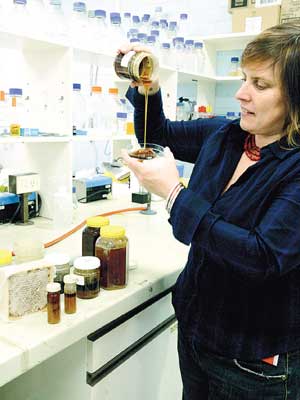
Use of Wound-Healing Honey Common in Australia
Honey, It Shrinks The Pain
By Fran Molloy, The Sydney Morning Herald (Australia), 6/22/2006
'There is no way I would let anyone treating me or my loved ones put anything except honey on our wounds," says Dr Shona Blair, a post-doctoral microbiology researcher at the University of Sydney.
Blair, who has been researching the properties of honey for more than six years, says there have been a large number of worldwide clinical trials showing that honey applied to various wounds has impressive healing properties.
Blair found that some types of honey are highly effective in killing many bacteria, including golden staph, (Staphylococcus aureus) - a major problem in hospitals because it is resistant to most antibiotics.
Honey also leaves infected wounds very clean, because of its ability to break down the "biofilm" found in many wounds. It also has anti-inflammatory properties, reducing pain, particularly in burns and ulcers. It also can reduce scarring.
Honey has been used as a remedy for thousands of years. The ancient Egyptians wrote about its curative properties when applied to wounds; similar references have been found in texts from ancient Greeks, Romans, Mesopotamians, Chinese and Indians. But, ironically, it could be honey's history of long-term use and natural origins that have prevented it from being widely used in hospitals, despite the overwhelming scientific evidence of its efficacy.
Dozens of clinical trials and more than 150 medical journal articles have been published, involving thousands of patients using honey as a wound dressing. Findings have shown that honey is effective in quickly clearing existing infection, protects wounds from further infection, minimises scarring and also reduces wound odours.
Various studies show medical honey to be effective in treating a huge range of injuries, including surgical wounds, burns, infectious wounds, ulcers and pressure sores as well as eczema, dry eye, dental wounds and even nappy rash…
By Fran Molloy, The Sydney Morning Herald (Australia), 6/22/2006
'There is no way I would let anyone treating me or my loved ones put anything except honey on our wounds," says Dr Shona Blair, a post-doctoral microbiology researcher at the University of Sydney.
Blair, who has been researching the properties of honey for more than six years, says there have been a large number of worldwide clinical trials showing that honey applied to various wounds has impressive healing properties.
Blair found that some types of honey are highly effective in killing many bacteria, including golden staph, (Staphylococcus aureus) - a major problem in hospitals because it is resistant to most antibiotics.
Honey also leaves infected wounds very clean, because of its ability to break down the "biofilm" found in many wounds. It also has anti-inflammatory properties, reducing pain, particularly in burns and ulcers. It also can reduce scarring.
Honey has been used as a remedy for thousands of years. The ancient Egyptians wrote about its curative properties when applied to wounds; similar references have been found in texts from ancient Greeks, Romans, Mesopotamians, Chinese and Indians. But, ironically, it could be honey's history of long-term use and natural origins that have prevented it from being widely used in hospitals, despite the overwhelming scientific evidence of its efficacy.
Dozens of clinical trials and more than 150 medical journal articles have been published, involving thousands of patients using honey as a wound dressing. Findings have shown that honey is effective in quickly clearing existing infection, protects wounds from further infection, minimises scarring and also reduces wound odours.
Various studies show medical honey to be effective in treating a huge range of injuries, including surgical wounds, burns, infectious wounds, ulcers and pressure sores as well as eczema, dry eye, dental wounds and even nappy rash…
Wednesday, June 21, 2006
Apitherapy in Nigeria
Gospel of the Busy Bee
By Oluwatoyin Malik, Nigerian Tribune, 6/21/06
To many people, the bee is a stinging insect that is dangerous to mankind and has no special attribute except the production of honey. However, this is not the case for Ayodele Ambali Salako, a popular apitherapist.
For Salako, the gospel of bees and honey goes beyond eating and extends to treatment of various kinds of ailments. Ailments like migraine, cancer, obesity, diabetes, infertility, fibroid, fallopian tube blockage and all types of fever-like jaundice, malaria, hay and others are included in diseases that can be treated with apiterapy.
A visit to the office of Ambali Salako, the man in charge of Salako - Oniluofeotu beekeeping Apiherapist revealed that quite a number of people are embracing the treatment of ailments through bee products known as Apitherapy.
Midweek Tribune gathered from him that apitherapy is natural healing and it is supported by the holy scriptures. Salako quoted from the Holy Quran to back his claim. He said, “the Holy Quran 16:68-69 says, the lord inspired the bees to put their nest (combs) in mountains, rocks, trees and in men habitations and the bees to eat the produce of the earth and release a product in varying colours which will be healing for mankind and the lord will make their way smooth. In this is a sign for those who think and give thoughts.”
Explaining this verse, Salako said the Lord has given the bee free access to produce materials that are beneficial to man. He added that, it also indicates that only men of thought who can do research, can understand these uses.
Salako also explained that the Holy Bible in Proverbs 24:13-14 also extols the virtues of honey. Using honey for treatment in various forms is becoming an household issue but what stands Salako out is the bee venom therapy; the art of using bees to sting humans for the purpose of curing them of various ailments. This is also known as the bee injection…
By Oluwatoyin Malik, Nigerian Tribune, 6/21/06
To many people, the bee is a stinging insect that is dangerous to mankind and has no special attribute except the production of honey. However, this is not the case for Ayodele Ambali Salako, a popular apitherapist.
For Salako, the gospel of bees and honey goes beyond eating and extends to treatment of various kinds of ailments. Ailments like migraine, cancer, obesity, diabetes, infertility, fibroid, fallopian tube blockage and all types of fever-like jaundice, malaria, hay and others are included in diseases that can be treated with apiterapy.
A visit to the office of Ambali Salako, the man in charge of Salako - Oniluofeotu beekeeping Apiherapist revealed that quite a number of people are embracing the treatment of ailments through bee products known as Apitherapy.
Midweek Tribune gathered from him that apitherapy is natural healing and it is supported by the holy scriptures. Salako quoted from the Holy Quran to back his claim. He said, “the Holy Quran 16:68-69 says, the lord inspired the bees to put their nest (combs) in mountains, rocks, trees and in men habitations and the bees to eat the produce of the earth and release a product in varying colours which will be healing for mankind and the lord will make their way smooth. In this is a sign for those who think and give thoughts.”
Explaining this verse, Salako said the Lord has given the bee free access to produce materials that are beneficial to man. He added that, it also indicates that only men of thought who can do research, can understand these uses.
Salako also explained that the Holy Bible in Proverbs 24:13-14 also extols the virtues of honey. Using honey for treatment in various forms is becoming an household issue but what stands Salako out is the bee venom therapy; the art of using bees to sting humans for the purpose of curing them of various ailments. This is also known as the bee injection…
Tuesday, June 20, 2006
Bee Venom Allergens May Help Produce Preventive Allergy Vaccine
Researchers from Japan, Brazil and Switzerland Report Recent Findings in Allergies
Science Letter, 6/23/2006
Allergies research advances have been reported from Japan, Brazil and Switzerland…
Study 3: A recombinant multi-allergen vaccine with reduced IgE binding and preserved T cell epitopes prevents allergy attacks.
According to recent research published in the European Journal of Immunology, "Novel approaches for the prevention of allergy are required, because of the inevitably increasing prevalence of allergic diseases during the last 30 years."
Fariba Karamloo at the Swiss Institute of Allergy and Asthma Research and collaborators throughout the world announced, "A recombinant chimeric protein, which comprises the whole amino acid sequences of three bee venom major allergens has been engineered and used in prevention of bee venom sensitization in mice."...
Karamloo and associates published their study in the European Journal of Immunology (Prevention of allergy by a recombinant multi-allergen vaccine with reduced IgE binding and preserved T cell epitopes. Eur J Immunol, 2005;35(11):3268-3276).
For additional information, contact Fariba Karamloo, Swiss Institute of Allergy and Asthma Research (SIAF), Obere Strasse 22, CH-7270 Davos, Switzerland. karamlooflory@compuserve.de.
Science Letter, 6/23/2006
Allergies research advances have been reported from Japan, Brazil and Switzerland…
Study 3: A recombinant multi-allergen vaccine with reduced IgE binding and preserved T cell epitopes prevents allergy attacks.
According to recent research published in the European Journal of Immunology, "Novel approaches for the prevention of allergy are required, because of the inevitably increasing prevalence of allergic diseases during the last 30 years."
Fariba Karamloo at the Swiss Institute of Allergy and Asthma Research and collaborators throughout the world announced, "A recombinant chimeric protein, which comprises the whole amino acid sequences of three bee venom major allergens has been engineered and used in prevention of bee venom sensitization in mice."...
Karamloo and associates published their study in the European Journal of Immunology (Prevention of allergy by a recombinant multi-allergen vaccine with reduced IgE binding and preserved T cell epitopes. Eur J Immunol, 2005;35(11):3268-3276).
For additional information, contact Fariba Karamloo, Swiss Institute of Allergy and Asthma Research (SIAF), Obere Strasse 22, CH-7270 Davos, Switzerland. karamlooflory@compuserve.de.
Monday, June 19, 2006
Florida: Trace Amounts of Antibiotics Found in Honey from China
State Threatens Fines Over Contaminated Honey
By Jim Ash, Tallahassee Democrat (USA), 6/15/2006
State investigators are threatening fines after finding trace amounts of antibiotics in honey imported from China.
Not found on store shelves but in processed foods, the honey is not considered to be an eminent health risk, said Terry McElroy, a spokesman for the Department of Agriculture and Consumer Services.
The Department recently sent letters to distributors warning them they face fines of up to $5,000 if follow-up testing shows any more of the substance, "fluoroquinolones," which is banned in the United States.
Earlier this year, the department began testing nearly 50 samples of honey from domestic and foreign sources, including 14 samples from honey imported from China. Four of the 14 Chinese samples showed levels of the substance ranging from 5 ppb, or parts per billion, to 93 ppb. The testing was done after officials received an anonymous tip, McElroy said…
By Jim Ash, Tallahassee Democrat (USA), 6/15/2006
State investigators are threatening fines after finding trace amounts of antibiotics in honey imported from China.
Not found on store shelves but in processed foods, the honey is not considered to be an eminent health risk, said Terry McElroy, a spokesman for the Department of Agriculture and Consumer Services.
The Department recently sent letters to distributors warning them they face fines of up to $5,000 if follow-up testing shows any more of the substance, "fluoroquinolones," which is banned in the United States.
Earlier this year, the department began testing nearly 50 samples of honey from domestic and foreign sources, including 14 samples from honey imported from China. Four of the 14 Chinese samples showed levels of the substance ranging from 5 ppb, or parts per billion, to 93 ppb. The testing was done after officials received an anonymous tip, McElroy said…
Sunday, June 18, 2006
Mesitran: New Honey-Based Wound Treatment Product
Medicinal Honey Products
Tania Alexander, Daily Mail (UK), 6/13/2006
Mesitran Ointment, 15g, Pounds 8.99
THIS product is made with medical-grade honey and is designed to treat pressure ulcers, burns, grazes and wounds…
Product Data Sheet
Tania Alexander, Daily Mail (UK), 6/13/2006
Mesitran Ointment, 15g, Pounds 8.99
THIS product is made with medical-grade honey and is designed to treat pressure ulcers, burns, grazes and wounds…
Product Data Sheet
Saturday, June 17, 2006
Palestinians Praise Medicinal Value of Thyme Honey
Palestinian Women Become Beekeepers
Reuters, 6/16/2006
A new beekeeping project launched by the East Hebron Area Development Programme (ADP) will allow 80 local women to establish their own business and help support their families.
Bani Naim is located 55 kilometers south of Jerusalem and is home to 10,000 people. The town was always famous for its honey, and the special medicinal value it has.
Beekeeping is usually a profession for men in the Palestinian territories, but the ADP that is interested in improving the status of women in the local community has decided to help women enter this profession to support their families…
The Italian hybrid bees purchased for the project are well known for their ability to live in areas where there are drastic temperature changes can collect nectar from a variety of plants especially the wild thyme that covers the hills around Bani Naim in the spring.
The wild thyme gives the Bani Naim honey a special flavour and medicinal values…
Reuters, 6/16/2006
A new beekeeping project launched by the East Hebron Area Development Programme (ADP) will allow 80 local women to establish their own business and help support their families.
Bani Naim is located 55 kilometers south of Jerusalem and is home to 10,000 people. The town was always famous for its honey, and the special medicinal value it has.
Beekeeping is usually a profession for men in the Palestinian territories, but the ADP that is interested in improving the status of women in the local community has decided to help women enter this profession to support their families…
The Italian hybrid bees purchased for the project are well known for their ability to live in areas where there are drastic temperature changes can collect nectar from a variety of plants especially the wild thyme that covers the hills around Bani Naim in the spring.
The wild thyme gives the Bani Naim honey a special flavour and medicinal values…
Thursday, June 15, 2006
Honey Prevents Antibiotics-Resistant Bacteria ‘Biofilms'
Eat Your Way To Health
Fay Burstin, Herald Sun (Australia), 6/15/2006
EVERYDAY foods found in most kitchen pantries and fridges could be leading a quiet household medical revolution.
Honey, lemons, ginger and orange juice are among some of the regular foods -- in ordinary doses, not extracts, essences or supplements -- whose remarkable healing properties are being discovered by doctors and scientists.
Honey is set to become the new medical champion in hospitals after researchers at the University of Wales Institute, Cardiff, found it could help fight potentially lethal antibiotics-resistant bacteria that protect themselves from attack by forming slimy clumps.
Biofilms prevent wounds from healing and cause chronic ulcers.
But the Cardiff team found biofilms on laboratory-grown bacteria from patients' injuries treated with manuka honey were disrupted, making them more susceptible to antibiotic treatment.
The research, which included impregnating dressings with manuka honey, could also have a big impact in developing countries where honey is cheap, available, easy to use and without side effects but where modern pharmaceuticals are difficult to get hold of…
Fay Burstin, Herald Sun (Australia), 6/15/2006
EVERYDAY foods found in most kitchen pantries and fridges could be leading a quiet household medical revolution.
Honey, lemons, ginger and orange juice are among some of the regular foods -- in ordinary doses, not extracts, essences or supplements -- whose remarkable healing properties are being discovered by doctors and scientists.
Honey is set to become the new medical champion in hospitals after researchers at the University of Wales Institute, Cardiff, found it could help fight potentially lethal antibiotics-resistant bacteria that protect themselves from attack by forming slimy clumps.
Biofilms prevent wounds from healing and cause chronic ulcers.
But the Cardiff team found biofilms on laboratory-grown bacteria from patients' injuries treated with manuka honey were disrupted, making them more susceptible to antibiotic treatment.
The research, which included impregnating dressings with manuka honey, could also have a big impact in developing countries where honey is cheap, available, easy to use and without side effects but where modern pharmaceuticals are difficult to get hold of…
Wednesday, June 14, 2006
Study: Honeydew, Thyme Honey Contain High Levels of Phenol
Honey – There’s More to It Than You Think
By Janette Busch, Scoop Independent News (New Zealand), 6/14/2006
While honey has the reputation of being a healthy food to consume, nevertheless, some people choose not to eat it because they consider it to be only a source of sugars that give no special health benefits.
Researchers in the Agriculture and Life Sciences Division at Lincoln University have recently completed the first study of the health promoting compounds of a range of honeys and honeydew produced in New Zealand. They discovered that some honeys contain health promoting compounds such as antioxidants and that the colour of the darker honeys may be an indication that they also contain high levels of minerals…
The honey studied all came from single varieties of flowers (mono-floral) and included: manuka, clover, rata, vipers bugloss, kamahi, nodding thistle, honeydew, rewarewa, tawari and thyme provided by Airborne Honey Limited of Canterbury…
Honeydew and thyme honey contained the highest levels of phenol compared to the other honeys, while thyme and rewarewa had the highest antioxidant activity of the ten honeys giving them the potential to play an important role in providing antioxidants to humans in a pleasant from…
By Janette Busch, Scoop Independent News (New Zealand), 6/14/2006
While honey has the reputation of being a healthy food to consume, nevertheless, some people choose not to eat it because they consider it to be only a source of sugars that give no special health benefits.
Researchers in the Agriculture and Life Sciences Division at Lincoln University have recently completed the first study of the health promoting compounds of a range of honeys and honeydew produced in New Zealand. They discovered that some honeys contain health promoting compounds such as antioxidants and that the colour of the darker honeys may be an indication that they also contain high levels of minerals…
The honey studied all came from single varieties of flowers (mono-floral) and included: manuka, clover, rata, vipers bugloss, kamahi, nodding thistle, honeydew, rewarewa, tawari and thyme provided by Airborne Honey Limited of Canterbury…
Honeydew and thyme honey contained the highest levels of phenol compared to the other honeys, while thyme and rewarewa had the highest antioxidant activity of the ten honeys giving them the potential to play an important role in providing antioxidants to humans in a pleasant from…
Subscribe to:
Comments (Atom)